Should Tyler Robinson receive the death penalty if convicted of murdering Charlie Kirk?
Random Sample: 30 California College Students (UCLA, Stanford, UC Merced, UC Berkeley)
No= 25 Yes= 1 Not Sure= 4
Watch California college students respond to whether Tyler Robison should receive a death sentence if convicted of murdering Charlie Kirk
**********************************
“LOVE ALL, TRUST A FEW, DO WRONG TO NONE.” (William Shakespeare)
All wrongdoing is ultimately subject to God’s judgment. While forgiveness is essential, it does not eliminate accountability or the natural consequences of actions. Romans 12:19 encourages Christians to entrust justice to God, rather than seeking personal revenge. Followers of Christ are called to overcome evil with good, demonstrate love even toward their adversaries, and practice forgiveness, thereby reflecting Christ’s character.
*********************************
PRE-TRIAL INSIGHTS: THE CASE OF CHARLIE KIRK vs. TYLER ROBINSON
COLLEGE STUDENTS REFLECT ON THE DEATH PENALTY DEBATE
SLING NEWS: The survey conducted among college students in California regarding the death penalty provides valuable insights into contemporary attitudes toward capital punishment, especially in light of the case involving Tyler Robinson and the alleged murder of Charlie Kirk. With a sample size of just 30 participants, the findings indicate significant opposition to the death penalty, with 25 students expressing disapproval.
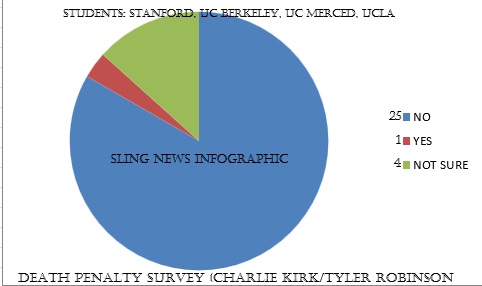
SLING NEWS: This overwhelming majority contrasts sharply with the single supporter of capital punishment in the group, while four students remained undecided. It is important to acknowledge the limitations of this survey, particularly its small sample size, which may not accurately represent the broader demographic of college students throughout California. Additionally, the timing of the survey—conducted during the pre-trial phase—adds complexity to the results.
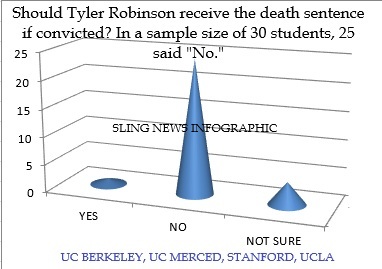
SLING NEWS: Public opinion on high-profile legal cases can be heavily influenced by media portrayals and changing societal attitudes, which may evolve as the trial progresses. The intention to revisit this topic with further data collection after the trial of Charlie Kirk versus Tyler Robinson reflects a thoughtful approach to understanding how the unfolding circumstances may impact public sentiment. This longitudinal perspective will provide a more comprehensive view of the factors influencing students’ opinions on the death penalty.

SLING NEWS: As results from subsequent surveys become available, it will be crucial to analyze any changes in opinion and discuss the implications for both the legal system and societal values surrounding capital punishment. By continuing this dialogue, we can cultivate a deeper understanding of the complex moral and ethical considerations involved in such significant legal matters.
TYLER ROBINSON, 22 YEARS OLD, AWAITING TRIAL FOR THE MURDER OF CHARLIE KIRK
Trial Date: Tyler Robinson’s preliminary hearing was postponed until January 16, 2026, and his arraignment will follow on January 30.
Location: Housed in the highest security unit (SHU) in Utah.
Isolation Measures:
– Designed specifically for serious offenses.
– Rigorous monitoring of daily activities, including sleeping and eating habits.
– Meals delivered through secure slots to reduce inmate interaction.
Cell Conditions:
– Dimensions: approximately 6×10 or 8×10 feet; no windows.
– Basic facilities include bolted sinks and toilets, designed to prevent self-harm.
Inmate Restrictions:
– Complete segregation from the general population.
– No access to communal recreation areas.
– Limited to six books from approved providers.
Legal Counsel Rights:
– Allowed to consult legal counsel, but meetings are under strict regulations.
– Consultations occur in designated rooms with glass separations, using telephones for communication.
DOES UTAH ALLOW THE DEATH PENALTY? Yes
SLING NEWS: Utah stands among the 27 states that still endorse this controversial practice. While over 50 inmates have faced execution in the past, the diminishing rate of executions in recent decades raises important questions about the ethics and effectiveness of the death penalty. Since the U.S. Supreme Court reinstated capital punishment in 1976, Utah has executed seven individuals, highlighting a trend of decreasing reliance on this extreme measure. (Source: Utah, KUTV, Utah Capital Punishment Laws by Lyle Therese A. Hilotin-Lee, J.D. | Legally Reviewed by FindLaw Staff | Last reviewed December 04, 2024, Utah Commission on Criminal and Juvenile Justice-gov.)
VOICES FOR JUSTICE: STEPHEN F. ROHDE ON THE IMPACTS OF CAPITAL PUNISHMENT
SLING NEWS: When reflecting on the implications of capital punishment, we cannot ignore voices like that of Stephen F. Rohde, who articulately highlights the profound issues surrounding capital punishment.
- Stephen F. Rohde is a former constitutional lawyer, lecturer, and political activist. He serves as the chair emeritus of the ACLU Foundation of Southern California and was the immediate past chair of Bend the Arc, a Jewish organization focused on justice.
- He has also held the position of President of the Beverly Hills Bar Association and founded Interfaith Communities United for Justice and Peace. He was the former chair of Death Penalty Focus. Rohde currently hosts the podcast “Speaking Freely: A First Amendment Podcast with Stephen Rohde.” He is the author of American Words of Freedom and Freedom of Assembly (part of the American Rights series).
Watch the complete interview here:
**********************************************
THE DEATH PENALTY: “A PERFECT PUNISHMENT IN AN IMPERFECT SYSTEM.” (Stephen Rhode)
***********************************************
“TYLER ROBINSON SHOULD NOT RECEIVE A DEATH SENTENCE IC CONVICTED OF MURDERING CHARLIE KIRK.” (Stephen Rhode)
Sling Digital 2024-2026
Copyright 2024-2026 ©Havah House Co. Policy Terms: the content of this website is a work of authorship and an intellectual property of Havah House Co. No portion of its content may be performed, reproduced, or used by any means, or disclosed to, quoted, or published in any medium without the consent of the owner.